


The role of AI in the Aftermarket Telematics space - Part 1

Updated: Apr 2, 2020
Artificial Intelligence (AI) is a key technology for current Auto-tech trends. Autonomous driving relies inherently on AI because it is the only technology that enables the reliable, real-time recognition of objects around the vehicle. In other automotive and smart mobility fields, AI is creating huge possibilities for unleashing actionable insights from different types and sources of data. This data can be related to vehicle sensors and ECUs, vehicle users and in case of commercial vehicles, also the operations they are involved in.
AI in a nutshell
But before diving into AI applications, opportunities and use cases in the automotive space, let’s take a step back and try to define the meaning and the role of AI in the technology-driven revolution we have been experiencing in recent years.
Artificial Intelligence can be defined as augmented Intelligence, helping humans to scale their capabilities and roles as machines do the time-consuming work. In a broader definition, we can look at AI as getting computers to do tasks that would normally require human intelligence. Nowadays, common state-of-the-art Artificial Intelligence, known as “narrow AI”, typically automates practical-purpose tasks which could be executed by humans, whereas it often outperforms humans in efficiency and endurance.
In the futuristic and widely debated era of general AI or “strong AI”, machines become as intelligent as a human being, who is expected to be able to plan, to solve problems and to be imaginative and creative. Not mentioning the need to experience consciousness as a major part of Human intelligence.
The values and benefits of today’s commercial AI-powered products are usually achieved using machine learning (ML), which is, just like natural language processing (NLP), a subset of AI. ML uses computer algorithms to analyze unknown data, based on mathematical models it was “trained” to apply using large amounts of sample data. The output of ML algorithm is expected to make intelligent decisions that are then used as the basis for recommendations, decisions, predictions and feedback mechanisms.
In the autonomous driving space, as an example, it is simply the ability of computer vision systems to continuously analyze streams of images and identify the different types of road lanes, traffic signs and other objects on the road, including vehicles, motorcycles, pedestrians, bicycles and static obstacles, in order to safely and lawfully self-navigate a vehicle from point A to point B.
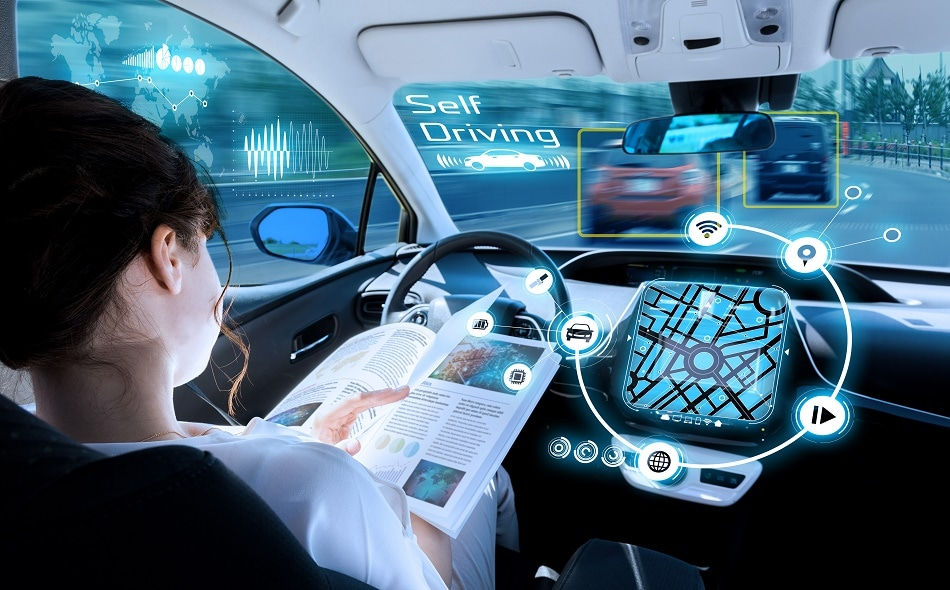
AI in Automotive and Smart Mobility
Artificial intelligence is used today in different fields of the automotive industry. It is used for ADAS, autonomous driving, driver monitoring systems, predictive maintenance, cyber security, visual inspection and more. In this post however, I will try to review how service providers and technology vendors in the aftermarket domain, rather than the OEMs domain, are harnessing these technologies in order to deliver the next generation of Telematics and smart Transportation solutions. This will eventually help fleet managers to make their jobs in a more productive, safe and streamlined fashion and to better address their business needs.
The data-driven organizations inflection point

In today's business world, information is the new currency, and the speed with which we can scale insight and the knowledge it brings is the basis for value creation and the key to competitive advantage in any technology-driven market. In a recent survey, NAFA - The North American Fleet Management Association, asked its members about their top challenges in order to identify the issues that will impact the near-future of their profession. The #1 challenge reported: “We are drowning in data”! And this is not surprising considering the amount of real-time data gathered from vehicles in a fleet of hundreds or even thousands of vehicles.
As collected data piles up, there are few basic problems which service providers and technology vendors must address:
Verify data sanity in near-real-time in order to avoid bias or erroneous insights
Ensure that the data is transformed into meaningful information and insights
Ensure data security in order to keep information safe from hackers
Comply with privacy and ethical-computing standards
Machine learning is making it possible to address the information extraction and decision-making challenge listed above, by quickly finding relevant patterns in data (which were before buried under enormous data mountains). The data is captured by connected devices and sensors installed in the vehicle, such as GPS tracking devices, Infotainment systems, vehicle security systems, CANBUS-connected dongles, smart cameras etc.
One of the trends in nowadays fleet management solutions is to equip the vehicle with on-board devices with larger computing power so that the edge devices can run real-time analytics on a variety of applications before sending crunched data and meaningful events to the server. Even in use cases where huge amount of raw data is being sent to the server, machine learning algorithms can be applied to continually refine its ‘trained model' for interpretation of big data sets. This can enhance the accuracy of derived information regarding driving behavior, vehicle utilization and overall operations KPIs and further improve safety, productivity and cost-efficiency of the fleet.
Between Automotive and Aftermarket
Facing the fact that AI-powered applications in the aftermarket Telematics space are influenced by auto-tech trends, an obvious question pops-up: Is the automotive industry the only driver for technologies which are later embraced by aftermarket vendors? Or are there aftermarket-unique-applications which can, and should be benefited by AI advances, and therefore shall be specifically designed for the aftermarket Telematics needs?
These questions have become more and more important over the past year as market experts have clearly admitted that the early dreams of level-4 and level-5 autonomous vehicles becoming a reality in scale is still many years away. As a result, several auto-tech startups are now forced to reconsider or recalculate their product and marketing strategies.
In the second part of this review I will try to introduce the most painful problems in the aftermarket Telematics space which can be solved by these technologies. We will discuss whether AI can, and shall be used in order to make reliable and accountable near-real-time decisions, predication and recommendations. I will cover the context of fleet and driver safety improvements, operation losses associated with cargo and asset security, as well as other aspects like fleet operations efficiency, large-scale transportation, logistics and more. I shall provide examples of emerging applications and solutions in nowadays aftermarket Telematics space and will try to predict what will be the ones to dominate in the months and years to come.
Thanks for getting that far and… stay tuned for the second part😊
Comments